Nigeria’s power system still relies heavily on captive diesel and petrol generators, with sizeable suppressed and unmet demand. The study by Shari et al. takes this reality as the starting point and uses the Open Energy Modelling Framework (oemof) to ask a question: given Nigeria’s 2060 net-zero target, how and where does green hydrogen make sense once you optimise the system transparently?
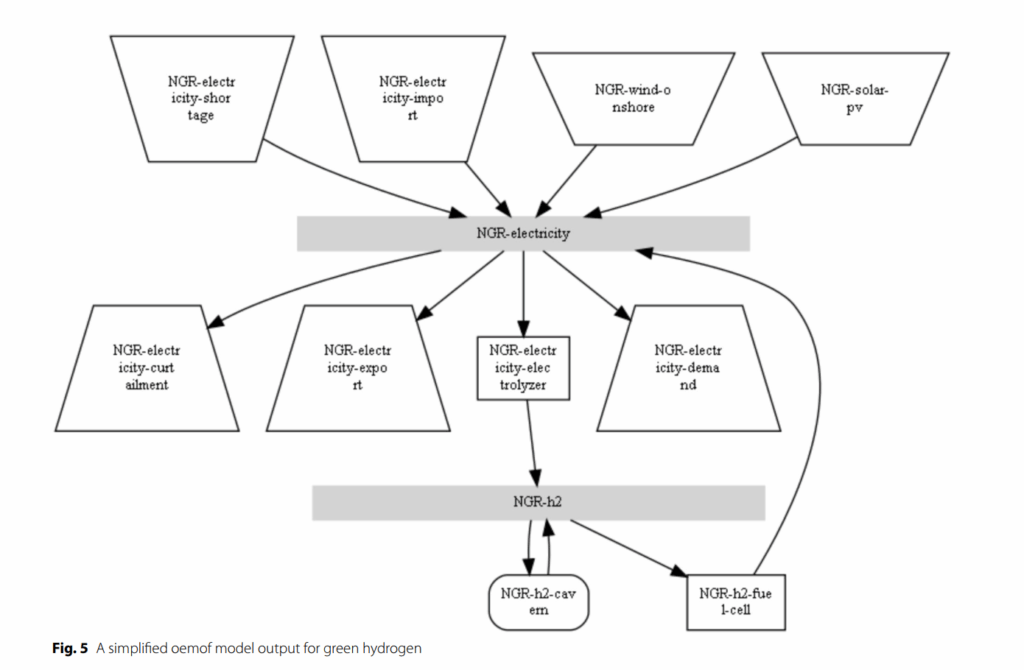
The model is implemented with oemof-solph as a cost-minimising linear optimisation. The energy system is represented in oemof’s graph structure which uses buses for carriers and components connected by flows. Electricity and hydrogen each have dedicated buses. Supply components include gas turbines and diesel sets alongside solar PV, onshore wind, hydropower and biomass. The hydrogen chain is modelled with standard solph components: an electrolyser transformer converts surplus electricity to hydrogen, a hydrogen storage component holds the gas, and a fuel-cell transformer reconverts it to electricity when needed. Batteries provide a parallel short-term storage route. Demand, exports and curtailment are represented as sinks. Figures in the paper show the reference energy system and a simplified green-hydrogen chain built exactly this way.